

Back-to-School: Helping Your Child Have a Healthy Start to the School Year
Help your child head back to school feeling rested, healthy, and ready to learn. Restore + Revive’s Nurse Practitioner, Emmaline Rhodes, shares practical back-to-school tips on sleep, nutrition, immune support, emotional wellness, and healthy routines that can set your family up for a successful school year.

By Emmaline Rhodes, FNP-C
Back-to-school season is exciting, but it also comes with a lot of change. After months of later bedtimes, flexible schedules, vacations, and more time outside, children are suddenly expected to wake up early, sit in the classroom all day, and adjust to new teachers, classmates, and routines.
For some kids, that transition is easy. For others, it can take a few weeks for their bodies and emotions to catch up.
The good news is that you don't have to completely overhaul your family's routine. A few intentional changes before school starts can help your child feel more rested, focused, and prepared for the year ahead.
Here are a few of the things I encourage families to focus on.
Start Resetting Sleep Before School Starts
One of the biggest adjustments children make isn't actually going back to school. It's resetting their internal body clock, also known as their circadian rhythm.
During the summer, later bedtimes and sleeping in are completely normal. But our bodies don't instantly adjust to an earlier schedule.
Instead of waiting until the night before school starts, begin adjusting bedtime and wake-up time 2–3 weeks before school begins. Try moving both earlier by about 15–30 minutes every few days. Small changes are much easier than one big shift.
Help Support the Transition
As you're adjusting your child's schedule, these simple habits can help support their natural sleep cycle:
Get outside for morning sunlight whenever possible.
Turn off screens at least an hour before bedtime.
Keep bedtime and wake-up times as consistent as possible—even on weekends.
Create a calming bedtime routine with reading, bath time/showers, or quiet conversation.
These habits help your child's brain recognize when it's time to be awake and when it's time to rest.
Why Sleep Matters
Sleep does so much more than prevent cranky mornings.
While your child sleeps, their brain is processing new information, their immune system is hard at work, and growth hormone is released to support healthy growth and development.
Children who consistently get enough sleep often have an easier time with:
Focus and attention
Emotional regulation
Learning and memory
Athletic recovery
Immune function
The American Academy of Sleep Medicine recommends 9–12 hours of sleep for children ages 6–12 and 8–10 hours for teenagers.
Fuel Their Brain for the School Day
Breakfast truly sets the tone for the rest of the day.
Many quick breakfast foods, like sugary cereal, pastries, or toaster waffles, are high in refined carbohydrates. These foods can cause blood sugar to rise quickly and then crash a few hours later, leaving children hungry, tired, or struggling to focus before lunch.
Instead, try building breakfast around protein, healthy fats, and fiber.
Some simple ideas include:
Eggs with fruit
Greek yogurt with berries
A protein smoothie packed with fruits, veggies, & fiber (chia seeds, flax, etc)
Whole-grain toast with peanut or almond butter + bananas and blueberries
Protein helps provide more steady energy throughout the morning and supports healthy brain function, growth, and muscle development.
Don't forget hydration, either. Even mild dehydration can affect concentration, mood, and physical performance. Sending your child to school with a reusable water bottle is one of the easiest ways to support them throughout the day.
Support Their Immune System
Back-to-school season also means increased exposure to germs. Kids are spending more time indoors, sharing classrooms, and likely interacting with many more people than they were over the summer.
While getting sick occasionally is a normal part of childhood, there are several ways to help support a healthy immune system.
The biggest difference makers are often the basics:
Prioritize quality sleep.
Eat a variety of whole, nutrient-dense foods.
Stay hydrated.
Encourage daily movement.
Spend time outside whenever possible.
These habits help support the immune system all year long, not just during cold and flu season.
What About Supplements?
Every child is different, and supplements should never replace healthy nutrition and lifestyle habits. That said, there are several nutrients we commonly discuss with families, especially during the school year.
Vitamin D
As children head back into the classroom, they're naturally spending less time outside.
Vitamin D supports bone health, immune function, and healthy growth. If your child spends most of the day indoors or has a known deficiency, talk with your healthcare provider about whether supplementation may be appropriate.
Omega-3 Fatty Acids
Omega-3s support brain development and may help support attention, learning, and overall brain health.
Good food sources include salmon, sardines, walnuts, flaxseed, and chia seeds.
Probiotics
A healthy gut plays an important role in immune function.
While not every child needs a probiotic, they may be beneficial in certain situations, especially after antibiotic use or for children with ongoing digestive concerns. Fermented foods like yogurt and kefir can also help support a healthy gut microbiome.
Vitamin C & Zinc
Vitamin C and zinc both play important roles in supporting normal immune function.
Most children can get plenty of these nutrients through a balanced diet rich in fruits, vegetables, lean proteins, nuts, and seeds. For some children, supplementation may be appropriate depending on their individual needs.
Rather than recommending the same supplements for every child, we prefer an individualized approach based on your child's health history, diet, and specific concerns.
Don't Forget About Their Emotional Health
Back-to-school isn't just a physical transition, it's an emotional one too.
Even children who love school may feel nervous about a new teacher, making friends, changing classrooms, or adjusting to a new routine.
Those feelings are completely normal.
One of the best things you can do is simply create space for your child to talk.
Ask questions like:
"What are you most excited about?"
"Is there anything you're feeling nervous about?"
"How can I help you feel more prepared?"
Sometimes children don't need us to fix the problem. They just need to know we're listening.
Build Small Moments of Calm
The school year can feel busy for the whole family.
Homework, sports, extracurricular activities, and packed schedules can leave very little downtime.
Creating just a few minutes each day to slow down can help children better manage stress.
That might look like:
Reading together before bed
Taking a family walk after dinner
Practicing a few deep breaths before school
Listening to music together
Spending a few quiet minutes outside
Praying together before bed
These simple habits help support emotional regulation and teach children healthy ways to manage stress.
A Healthy Start to the School Year
Back-to-school season is also a great time to check in on your child's overall health.
Whether your child needs an annual wellness visit, a sports physical, help managing ADHD, support for sleep concerns, or you're looking for a more root-cause approach to recurring illnesses, our pediatric team is always here to help.
We believe every child deserves care that's personalized to their unique needs. Sometimes that means answering questions about nutrition or supplements. Other times, it's helping families get to the root of ongoing concerns like fatigue, digestive issues, anxiety, or frequent illnesses.
Our goal is to partner with families and support children through every stage of growth and development.
Connect with us
If you have questions about sleep, nutrition, immune health, anxiety, ADHD, or your child's overall wellness, we'd love to partner with your family.
Call Restore + Revive at 817-720-6220 to schedule an appointment or learn more about our pediatric services.
Meet Emmaline Rhodes
Emmaline Rhodes is a pediatric nurse practitioner at Restore + Revive, trained at Vanderbilt University with a background in pediatric nursing. Her clinical experience led her to integrative medicine, where she developed a strong interest in root-cause, whole-child care.
She focuses on helping families implement practical, sustainable plans for children with ADHD and other pediatric concerns, with an emphasis on structure, regulation, and daily support. Emmaline is passionate about supporting the mind, body, and spirit of each child while helping families feel confident and supported in their care journey.
Disclaimer: The information provided in this blog is for educational and informational purposes only and is not intended as medical advice. Always consult with your healthcare provider before starting any new service, product, or treatment. Please note that prices, offerings, and other details mentioned in this post reflect information available at the time of publication and may have changed since.
Does My Child Have Retained Reflexes?
Could retained reflexes be affecting your child's development? Pediatrician Dr. Shane Rainey explains what retained primitive reflexes are, common signs to watch for, when reflexes should disappear, and how movement, therapy, and early support can help children thrive.
From clumsiness and poor posture to attention challenges and sensory sensitivities, Dr. Shane Rainey shares common signs of retained primitive reflexes and what parents should know.
As parents, we often celebrate major milestones like rolling, crawling, walking, and talking. What many people don't realize is that before these milestones can develop, babies rely on a series of automatic movements called primitive reflexes (Healthline).
These reflexes are present from birth and help infants survive, grow, and build important neurological connections. As a child's brain matures, these reflexes should gradually disappear, allowing more purposeful and coordinated movement to take over.
When a reflex remains active beyond the age it typically should, it may be referred to as a retained primitive reflex.
What Are Primitive Reflexes?
Primitive reflexes are involuntary movement patterns controlled by the brainstem. They are normal and necessary during infancy, helping with feeding, protection, posture, and early motor development.
As higher brain centers mature, these reflexes become "integrated," meaning the child gains voluntary control over movement instead.
Think of primitive reflexes as the training wheels of early development. They're helpful at first, but eventually children need to outgrow them to develop more advanced motor and cognitive skills.
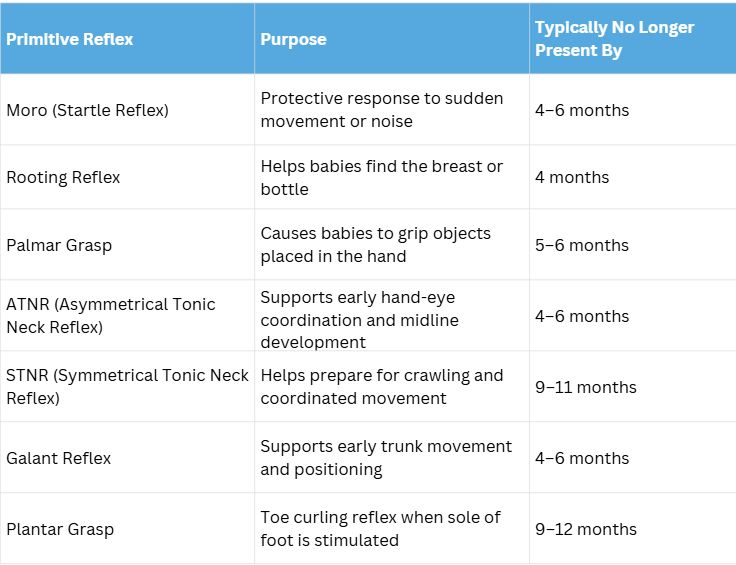
Common Primitive Reflexes and When They Typically Disappear
As a child's nervous system matures, primitive reflexes gradually fade away and are replaced by more purposeful, voluntary movement. Most primitive reflexes should no longer be present after the ages listed below.
Why Do Reflexes Become Retained?
In many children, reflex integration happens naturally with normal development. However, some factors may contribute to reflexes remaining active longer than expected.
Possible contributing factors include:
Premature birth
Birth trauma or difficult deliveries
Limited tummy time during infancy
Delays in gross motor development
Neurological differences
Lack of opportunities for varied movement experiences during infancy
Certain developmental disorders or neurological conditions
In many cases, there is no single identifiable cause of retained primitive reflexes. Some children may have contributing factors such as prematurity, limited early movement experiences, or developmental delays, but many children with retained reflexes do not have any clear risk factors at all.
It is also important for parents to know that this is not something they caused. Even in cases where contributing factors are NOT present, development is complex, and these patterns can simply occur as part of how a child’s nervous system matures.
How Can Retained Reflexes Show Up in Children?
Retained reflexes don't always present in obvious ways. Instead, parents may notice challenges in areas such as movement, coordination, attention, posture, or learning.
Retained Moro Reflex
Easily startled
Sensitivity to noise, light, or movement
Difficulty with emotional regulation
Anxiety or heightened stress responses
Retained ATNR (Asymmetrical Tonic Neck Reflex)
Difficulty crossing midline
Awkward pencil grip
Challenges with reading and tracking across a page
Poor hand-eye coordination
Retained STNR (Symmetrical Tonic Neck Reflex)
Slouched posture
Difficulty sitting still
Challenges with crawling history
Poor coordination during sports or playground activities
Retained Galant Reflex
Sensitivity to clothing, waistbands, or seams along the lower back
Constant fidgeting or difficulty sitting still in a chair
Tendency to squirm, shift, or move when sitting for schoolwork or meals
Difficulty maintaining upright posture while seated
In some cases, bedwetting or nighttime restlessness
General Signs
Clumsiness
Balance difficulties
Delayed motor milestones
Motion sensitivity
Difficulty with coordination tasks such as catching, throwing, or bike riding
Research has found associations between persistent primitive reflexes and challenges with motor skills, posture, coordination, and some aspects of learning and attention, although the strength of these relationships is still being studied.
An Important Note About the Research
The topic of retained reflexes has received significant attention in recent years. While studies have found associations between persistent reflexes and developmental challenges, experts continue to debate how much retained reflexes directly cause these difficulties. Current evidence suggests that retained reflexes may be one contributing factor rather than the sole explanation for attention, learning, or behavioral concerns.
For this reason, a comprehensive developmental evaluation is often more helpful than focusing on reflexes alone.
What Can Parents Do?
My biggest recommendation if you suspect your child may have retained reflexes is not to panic that something is wrong with your child. Instead, simply get them moving. Movement is one of the primary ways children develop and strengthen the neurological pathways that support coordination, balance, body awareness, and motor control.
Encourage Active Play & Purposeful Movement
Children learn through movement, and some simple exercises can help support body awareness, coordination, balance, and motor control.
Try incorporating activities such as:
Wall push-ups to build upper body strength, shoulder stability, and body awareness.
Snow angels on the floor to encourage coordination between the right and left sides of the body.
Cross-body marching (marching while touching the opposite hand to the opposite knee) to support crossing midline and coordination.
Marching with arms extended while turning the head side to side and maintaining a straight walking path.
Bear crawls across the room.
Crab walks for core and shoulder strength.
Army crawling on the stomach.
Bird-dog exercises (on hands and knees, extending the opposite arm and leg while maintaining balance).
Wheelbarrow walks with a parent holding the child's legs.
Balance beam walking using a line on the floor, curb, or balance beam.
Hopping on one foot and alternating sides.
Jumping jacks to promote coordination and body awareness.
Monkey bars and climbing structures to strengthen core muscles and coordination.
Obstacle courses that incorporate crawling, climbing, balancing, jumping, and crossing midline.
Yoga poses such as Tree Pose, Downward Dog, and Bird Dog that challenge balance and body control.
One of my general recommendations is simply encouraging activities that naturally incorporate crawling, climbing, balancing, crossing midline, and coordinating both sides of the body together. These movement patterns help build the foundation for more advanced motor skills, attention, and body awareness.
Don't Underestimate Play
Many of the best "activities" don't feel like activities at all. Time at the playground, riding bikes, swimming, gymnastics, martial arts, dance, hiking, and active outdoor play can all provide valuable movement experiences that support healthy neurological development.
Prioritize Outdoor Play
Outdoor environments naturally challenge a child's balance, coordination, strength, and spatial awareness. Running, hiking, exploring uneven terrain, and climbing all provide valuable opportunities for the nervous system to develop and mature.
Don't Skip the Basics
Many of the activities that support healthy development are surprisingly simple:
Limiting excessive screen time
Encouraging active free play
Participating in sports and recreational activities
Building core strength through climbing and crawling
Spending time outdoors
These everyday movement experiences can have a powerful impact on a child's overall development.
When Additional Support May Be Helpful
If you've noticed your child is struggling and movement-based play and at-home activities aren't leading to improvement, or if a teacher, pediatrician, or other third-party recommends exploring additional support, several therapies may be beneficial.
The options I most commonly recommend include occupational therapy, chiropractic care, physical therapy, and, in some cases, a developmental vision evaluation. The best choice depends on your child's specific challenges and developmental needs.
Occupational Therapy
A pediatric occupational therapist can evaluate:
Motor coordination
Sensory processing
Fine motor skills
Visual-motor integration
Handwriting and school-related skills
Occupational therapists often incorporate movement-based activities designed to support motor development and reflex integration.
Chiropractic Care
Many of our families choose to work with a pediatric chiropractor who has experience evaluating nervous system function and movement patterns in children. Some children may benefit from an approach that focuses on posture, movement, and overall nervous system support.
Physical Therapy
For children with gross motor delays, balance concerns, muscle weakness, or coordination challenges, physical therapy can help improve strength, stability, movement patterns, and overall function.
Vision Evaluation
Because some retained reflexes may influence visual tracking and eye coordination, a developmental vision evaluation can be helpful for children experiencing challenges with reading, eye tracking, or visual-motor skills.
When Should Parents Be Concerned?
Parents should consider discussing concerns with their pediatrician if they notice:
Persistent coordination difficulties
Delayed motor milestones
Frequent falls
Difficulty with handwriting not improving with age
Poor posture
Significant sensory sensitivities (clothing, etc)
Challenges with attention that affect school performance
Most importantly, concerns should be evaluated within the context of the child's overall development rather than focusing on any single reflex alone.
Concerned Your Child May Have Retained Reflexes?
If you've noticed challenges with coordination, balance, posture, attention, sensory sensitivities, or other developmental concerns, don't hesitate to bring them up with your pediatrician.
Many retained reflexes can be screened through simple movement-based assessments performed during an office visit. These evaluations help us determine whether retained reflexes may be contributing to your child's challenges and whether additional support could be beneficial.
While primitive reflexes are covered in pediatric training, more advanced assessment of retained reflexes and their potential impact on development often requires additional education and clinical experience. At Restore + Revive, we can help evaluate your child, provide guidance, and connect your family with trusted specialists when appropriate.
Most importantly, if you have concerns about your child's development, trust your instincts. Early evaluation and support can make a meaningful difference.
Contact
We would love the opportunity to meet your child, answer your questions, and help determine the best next steps for your family.
Contact our office at 817-720-6220 ext. 2 to schedule an appointment.

From PCOS to PMOS: Why This Change Matters — and Is Long Overdue
PCOS is now being reclassified as PMOS, or polyendocrine metabolic ovarian syndrome, to better reflect the hormonal, metabolic, and whole-body nature of this condition. In this blog, Dabney Poorter, FNP-C, shares why the change matters, why it feels long overdue, and how Restore + Revive approaches care by asking a deeper question: why is this happening?

A functional medicine perspective from Dabney Poorter, FNP-C, Founder of Restore + Revive
This is a topic that feels especially personal to me.
I see patients in our practice every week who are struggling with symptoms that have been brushed off, misunderstood, or reduced to something far too simplistic. And as a mom to young girls, this conversation matters to me on an even deeper level. I care not only about how we care for women now, but also about what kind of awareness and support the next generation will grow up with.
For years, PCOS (Polycystic Ovary Syndrome) was the name many women were given for a slew of symptoms they were experiencing. But for a lot of patients, that label only captured the surface of what was really going on.
That is why this recent name change matters, and feels long overdue. The condition previously known as PCOS has now been renamed PMOS- polyendocrine metabolic ovarian syndrome. The new name better reflects the full-body nature of what so many women have actually been experiencing all along. (The Lancet; Endocrine Society)
What PCOS “was”
PCOS was the term used for a condition often associated with:
Irregular or missing periods
Lack of ovulation
Elevated androgens (hormones that help regulate skin, hair, and reproductive health)
Acne and oily skin
Facial hair growth or scalp hair thinning
Fertility challenges
Insulin resistance
Weight gain or difficulty losing weight
The name PCOS never told the whole story. Many women diagnosed with PCOS did not have ovarian cysts, and cysts were never required for diagnosis in the first place. That mismatch has caused confusion for years. (WHO ; The Lancet)
Why the name changed to PMOS
This was not a random “rebrand” or thoughtless name change.
The name change came out of a 14-year international effort involving researchers, physicians, advocacy groups, and patients themselves. More than 50 organizations were involved, and more than 22,000 survey responses helped shape the outcome. It was driven by growing recognition that the old name was scientifically incomplete and often misleading. (Endocrine Society; The Lancet)
The new name matters because it reflects what this condition actually involves:
Polyendocrine: multiple hormone pathways are involved
Metabolic: insulin, blood sugar, weight, inflammation, and cardiometabolic health are often part of the picture
Ovarian: ovarian function still matters, but it is no longer presented as the whole story
In other words, this condition has always been about more than just ovaries. (University of Colorado Anschutz ; Endocrine Society)
What PMOS includes now
This is not a brand-new condition. It is a more accurate name for the condition many women have long known as PCOS.
For adults, diagnosis still generally involves meeting 2 out of 3 criteria after ruling out other causes:
Irregular or absent ovulation
Clinical or lab evidence of elevated androgens
Polycystic ovaries on ultrasound or elevated AMH (Anti-Müllerian Hormone)
For adolescents (10–19 years old), the criteria are more specific. Diagnosis requires:
Ovulatory dysfunction
Hyperandrogenism (an imbalance of androgens, or hormones that can affect skin, hair, and cycles)
That matters because cycle irregularity can be common early on, and we want to be thoughtful about over- or under-diagnosing younger girls. (The Lancet)
Why this matters for women and girls
One of the biggest issues with the old name is that it often led women to dismiss or question their own symptoms.
It made it easier to think:
“I do not have cysts, so maybe I do not have this.”
“Maybe this is only about fertility.”
“Maybe my skin, cycles, weight, fatigue, and hormones are all separate issues.”
But they often are not separate at all.
This condition can affect:
Hormone balance
Metabolism
Menstrual cycles
Ovulation
Skin and hair
Mood and mental health
Long-term cardiovascular risk
That is exactly why a broader, more accurate name matters.
PCOS Is on the Rise
This is not rare, and it is not something we should only start talking about in adulthood.
A closer look at the numbers:
It affects about 1 in 8 women worldwide, or roughly 10–13% of reproductive-aged women
Up to 70% of women may still be undiagnosed
It can begin as early as adolescence
Among adolescents and young women ages 10–24, one global analysis found incidence increased by 56.02% and prevalence increased by 58.55% from 1990 to 2021
A meta-analysis found adolescent prevalence estimates ranging from 3.39% to 11.04%, depending on the diagnostic criteria used
As a provider, that is something I pay close attention to. And as a mom to young girls, it makes this conversation feel even more important. We need earlier awareness, earlier support, and better conversations for younger generations.
Our functional medicine perspective on PMOS
While we embrace this updated name and the more accurate diagnostic framework, at Restore + Revive, we have been caring for patients with a “why is this happening?” approach since the day we opened our doors.
We do not just look at the label. We strive to look at the full picture and person sitting in front of us.
This often includes discussing and reviewing:
Hormone patterns
Insulin resistance and blood sugar swings
Inflammation
Nutrition
Sleep
Stress
Movement and muscle health
Gut health, when relevant
Long-term metabolic risk
For many women, the symptoms under this diagnosis are deeply connected. Most of the time, they involve some combination of hormones, metabolism, and lifestyle factors.
That is where a functional medicine approach can be so helpful. Instead of chasing symptoms one by one, we step back and ask what is driving the pattern in the first place. (WHO ; American Society for Reproductive Medicine)
What we want women and families to know
If you have been dealing with irregular cycles, acne, hair changes, weight resistance, fertility concerns, or signs of hormone and metabolic imbalance, please know this:
Your symptoms are worth paying attention to
This condition is about far more than ovaries
The old name did not always reflect the full reality of what many women were experiencing
And earlier support can make a real difference
We also know these symptoms are not limited to adults. At Restore + Revive, we have providers who care for both adults and adolescent patients, so we can support women as well as younger girls who may be starting to experience these patterns early.
Next Steps
If this resonates with your story, we would love to help.
At Restore + Revive, our goal is to offer care that is personalized, root-cause focused, and grounded in the understanding that hormone health, metabolic health, and lifestyle are all connected.
Call us at 817-720-6220 ext 2 to schedule an appointment and learn more.
About Dabney Poorter
Dabney Poorter, FNP-C (Family Nurse Practitioner-Certified), is the Founder of Restore + Revive and is passionate about helping patients feel their best through research-based, personalized care. With a background in kinesiology, nursing, nutrition, and integrative medicine, Dabney takes a whole-body approach that includes in-depth health history review, lab interpretation, nutrition support, supplement guidance, and medication management. As a Family Nurse Practitioner, Certified Nutritionist, lifelong learner, and mom of two girls, she is deeply committed to equipping and empowering patients at every stage of their health journey.